Monday, December 22, 2025

Observations

 Jackson Street, 2025
 
I've been writing a newsletter of sorts, kind of like an emailed blog post, or something that could be seen on social media, but perhaps a bit longer, maybe similar to sitting with a friend telling you some things she’s been thinking about, but a short story or poem could also appear, and I’ll send you updates about my writing. Basically, when the mood strikes, not too often, I’ll write something and send it to you, sometimes with a photo or two. It's called Observations.  
 
If you'd like to read some past issues you can do so here. Scroll to the bottom of the page and enter your email address if you'd like to receive Observations in your inbox.   
 
Thank you for reading. If you have any questions or suggestions, send them my way.

Monday, May 27, 2024

Saturday, June 17, 2023

About My Writing

Wildflower, 2021 

Just popping in here to let you know my first email will go out to my mailing list next week. I actually prefer writing here, but maybe it's time for a change. The emails about my writing will be few and far between, so I hope if you're already signed up that cadence suits you. If you haven't signed up yet, I hope you will. 

Sign up for my mailing list here.

Wednesday, October 26, 2022

Autumn 2022

At the Park, Autumn 2022

Am I alone here now? I think so, but I'm not ready to let this space go, so I'm going to pop in and post a photo and a few words every once in a while. Why not. At this point, I don't really know what a blog is for, I'm not sure I've ever known, so I'm just going to share whatever I feel like sharing, like I always have.

I'm curious about so many things it is impossible to keep track of all I'd like to learn more about. The Montessori method of education is one of those things. Whenever it is mentioned I think, I should look this up. So I guess I finally did, at some point, because I found this quote in one of my old journals:

“The first step in becoming a Montessori teacher is to shed omnipotence and to become a joyous observer. If the teacher can really enter into the joy of seeing things being born and growing under his own eyes and clothe himself in the garment of humility, many delights are reserved for him that are denied to those who assume infallibility and authority in front of the class.” —Maria Montessori, To Educate the Human Potential (1947)

I can see why I wanted to save it. Sure, it's about teaching, but it also seems a good first step in becoming a decent person. Shed omnipotence, joyously observe, practice humility. Yes, yes, and yes. Assuming infallibility is ridiculous. Thank you, past self, for saving this for me.

Friday, May 14, 2021

Everything Changes

Tiny Moon, 2021
 

Hello. Thank you for visiting.

I've recently gotten word that the "Follow by Email" feature on this blog platform is going to be discontinued in July 2021. I'm not sure when I'll be writing my next post here, but if you’d like to keep informed about my other writing, I’ve added a section to the bottom of the home page of my website where you can add your name to my email list. I’ll let you know when I am releasing something new into the world.

Be well.

Thursday, March 11, 2021

What Will It Be?

After Hill 88, 2021

How has close to an entire year passed since I’ve been here? So much has changed, yet many things remain the same, at their core, including me. 

Our country has new leadership, there are now multiple vaccines to help wind down this pandemic, and my hair is longer than it has ever been, yet the sun still rises and sets each day, the moon continues to move through its phases, and the same tree in front of my living area window dapples my light. 

My life is old and new. Just when I believe wisdom is settling in I discover something life-changing that was within my reach for years, but I missed, and I feel grateful, and humbled. I’m reminded there will always be more. More to appreciate. More to learn. 

I hear a robin nearby, belting out a tune—bold and beautiful. Is it a call to do something big today? What will it be?

Thursday, March 26, 2020

Would you like someone to read to you?


Hello?

Hello...

Is anyone still out there? Anyone who isn't already communicating with me on Instagram? If so, hi there. It's nice to see you again.

I haven't been here in so long... Typing on this screen feels as if I've traveled back in time, which might not be such a bad thing, considering we're in the middle of a pandemic.

The pandemic is actually what made me think of this space. I wanted to let you know that I started recording myself reading "After the Sour Lemon Moon" aloud. My intention is to offer a space away from the stress so many of us are feeling about the current situation we are all in. Part one and part two are currently in my regular Instagram posts. Part three is coming soon.

I also contributed to a Point Reyes Books project called Quarantine Poems. You can watch a video of a poem being read to you each day. On Tuesday I read Ada Limón's poem, "Oranges & the Ocean." You can see it, as well as the other quarantine poems, by taking a look at Point Reyes Books on Instagram.

Thank you for stopping by.

Be safe. Be well.

Thursday, November 15, 2018

After the Sour Lemon Moon


We’re back in business! After the Sour Lemon Moon has a new printer.

If you'd like a copy for yourself, or to give as a gift, you can visit, call, or order online from your favorite independent local bookstore. After the Sour Lemon Moon can also be found in the usual online haunts, and as an eBook. 

Enjoy.

Monday, June 25, 2018

Letting Go and Holding On


I've been returning to Annie Dillard's essay, Living Like Weasels. (Thanks, Chris.) I am particularly drawn to her last few paragraphs

her reflections on letting go,
"I would like to learn, or remember, how to live. I come to Hollins Pond not so much to learn how to live as, frankly, to forget about it. That is, I don't think I can learn from a wild animal how to live in particularshall I suck warm blood, hold my tail high, walk with my footprints precisely over the prints of my hands?but I might learn something of mindlessness, something of the purity of living in the physical sense and the dignity of living without bias or motive."
and holding on.
"I think it would be well, and proper, and obedient, and pure, to grasp your one necessity and not let it go, to dangle from it limp wherever it takes you. Then even death, where you're going no matter how you live, cannot you part. Seize it and let it seize you up aloft even, till your eyes burn out and drop; let your musky flesh fall off in shreds, and let your very bones unhinge and scatter, loosened over fields, over fields and woods, lightly, thoughtless, from any height at all, from as high as eagles."
If you haven't read Living Like Weasels, I highly recommend finding and reading the entire essay to see these excerpts in context, and feel the full force of Annie Dillard's raw, rugged, inquisitive nature, and if you have read it, I suggest a return.

Monday, June 4, 2018

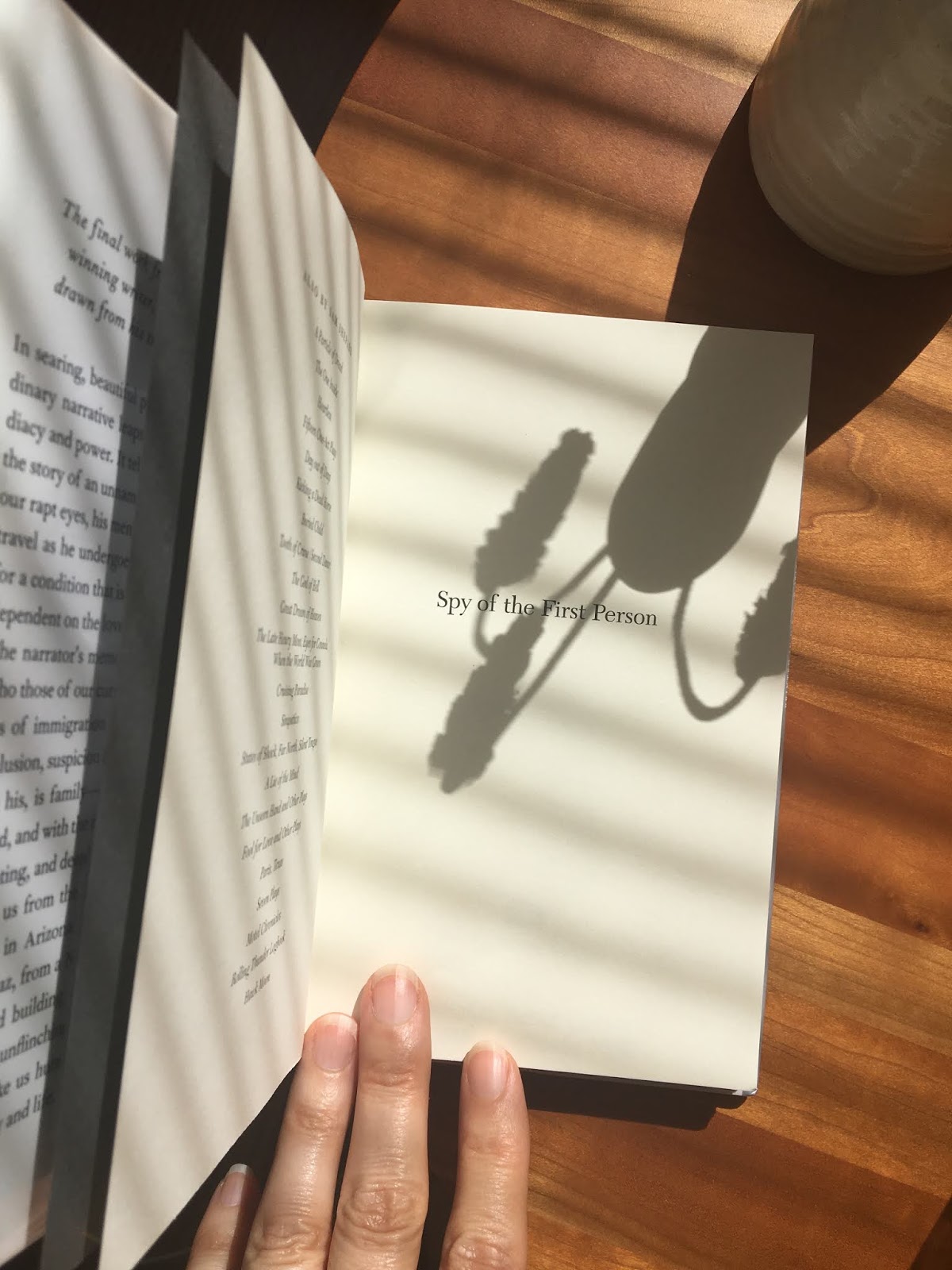
Spy of the First Person

Impermanence, 2018

I didn't even know it had been published. It was a library find. I don't think there's a better way to find a book than browsing.

I'm still in the trance this book, Sam Shepard's final work, Spy of the First Person, put me in. I can only describe this book as what appears to be an honest documentation of a creative mind making its final transition from here to wherever it is we go when we leave this place.

Although there is nothing about this slim book, with its strange dreamlike text surrounded by ample white space, that would classify it as a "page turner," it has a sense of urgency that once I'd picked it up would not let me put it down. It was much more like standing before Shepard in his rocking chair on his front porch and hearing him speak his final words than what I was actually doing, reading a book. I was not at all surprised to learn Patti Smith assisted Shepard in editing the manuscript.

"... I got to the hedge which was neither a camellia hedge or a hydrangea or anything like that. It was unidentifiable. There were white flowers coming out of it but I didn't quite know what they were. I can make him out through the white flowers, through the hedge. But I wasn't quite sure. I could make something out through there, but I wasn't sure what. Oh never mind, I'll figure it out later. That's the thing about later. You don't know what's coming up. You don't know how all the loose ends are going to gather together. Something for sure is going to happen but you don't know what it is. For instanceI'm outside, for instance. Out here with the birds and the bugs. Not exactly outside, but close enough. Just across the way. It's never like it was. The clouds. The big sky. The flowers. The chirping."

I'm now looking at everything I see through the lens of impermanence. The back cover categorizes the book as fiction, but it felt very real to me.

Wednesday, March 28, 2018

Do you know about Slow Club Book Club?

 Selection #2, 2018

If you haven't heard of Slow Club Book Club by Literary North, you might want to check it out.

It's the first book club I've really wanted to join. All I had to do was read their introduction and I was hooked:
Did the frantic pace of 2017 drain the energy out of you? Are you looking for the calm quiet inside? Do you want to slowly enjoy a few good books with like-minded sloths? // If so, this is the book club for you. Just four books that will take us from January through December 2018. No commitments, no shouting, no rushing. // Sound good? Subscribe and we'll send you the brief, no-hassle details. // Slowly yours, Shari & Rebecca
We begin reading our next selection April 1st.

No hurry, obviously.

Wednesday, February 14, 2018

Wait for the Light

Ranunculus, 2018

I read Pablo Neruda's poem, "Emerging," this morning. Then I read it again. Then I had it read to me. Then I read it one more time. I'll probably read it again later today.

This is the beginning of the poem:

A man says yes without knowing
how to decide even what the question is,
and is caught up, and then is carried along
and never again escapes from his own cocoon;
and that’s how we are, forever falling
into the deep well of other beings;
and one thread wraps itself around our necks,
another entwines a foot, and then it is impossible,
impossible to move except in the well —
nobody can rescue us from other people.

But this is just an excerpt. If you'd like to find the rest of this poem, and I think you should, I'm aware of a few options.

You can locate a copy of Neruda's book of poems, Extravagaria, and read it there. If you subscribe to The Paris Review, you can read this poem on their website. If you prefer someone read it to you, you are in luck. You can listen to The Paris Review's podcast, Episode 11, (also on their website, no subscription necessary) at the 01:22 mark and hear this poem in its entirety. Alternatively, if you can track down a copy of their Spring 1974 issue, you'll find this poem in print.

Enjoy.

Thursday, January 18, 2018

Blood Orange Upside-Down Cake


Before you read my recipe you should know that I rarely follow recipes. There are exceptions, of course, but typically I look at a bunch of recipes and either combine them or select one and make a bunch of changes.

Most of my inspiration for this cake came from this Baking the Goods recipe, found during a Google search while trying to find an old recipe I'd once made. I never found the old recipe, but I was still very pleased with this cake.

There are just so many things to consider with recipes. There's what you happen to have in your pantry and in your refrigerator. There are your personal preferences. There are the kitchen tools you own and do not own. There is the heat of your oven. Your elevation. Your mood. And on and on and on. It's kind of a miracle that recipes ever work at all.

So, since some pals on Instagram asked, I'm just going to tell you how I made this cake this afternoon. I'll try and remember as many details as possible. You'll have to consider all of the items in the paragraph above and make changes where applicable.

Here we go... 

Blood Orange Upside-Down Cake

2 tablespoons Miyoko's vegan butter
1/4 cup brown sugar
3 small blood oranges
1 1/2 cups all-purpose flour
3/4 cup instant polenta
1 1/2 teaspoons baking powder
1/2 teaspoon fine salt
Crushed seeds from 10 green cardamom pods
1/2 cup raw sugar
One 5.3 ounce container of vanilla soy yogurt
1/2 cup olive oil + enough to grease a cake pan
1 teaspoon almond extract
3 tablespoons flax meal 
Zest from your 3 small blood oranges

Grease cake pan and set aside.

Put 3 tablespoons of of flax meal + 9 tablespoons of water in a small bowl, whisk together with a fork, and set aside.

Melt 2 tablespoons butter and pour into bottom of cake pan.

Sprinkle brown sugar evenly over melted butter in cake pan.

Zest all 3 oranges and set zest aside.

Thinly slice oranges, leaving peel intact, and gently place enough slices over the butter and brown sugar to cover the bottom of the cake pan.

Slice off the peels of the remaining orange slices, rough chop, and fill in the open spaces around the slices in the cake pan. Set extra chopped orange pieces aside.

Crack open cardamom pods, remove seeds, and crush seeds in mortar with pestle.

Preheat oven to 350 degrees.

In a medium bowl whisk together flour, polenta, baking powder, cardamom, and salt. Set aside.

In a second medium bowl combine raw sugar, yogurt, and 1/2 cup olive oil and whisk together until combined and smooth.

Take flax meal and water you set aside earlier and whisk with fork one more time. It should have thickened by now. Add all of it to wet ingredients, along with almond extract, and whisk again until combined and smooth.

Add orange zest and any remaining chopped orange pieces to wet ingredients and gently stir to distribute evenly.

Fold dry ingredients into wet ingredients, adding only 1/3 of dry ingredients at a time. Fold each addition gently, only folding until all dry ingredients are wet.

Gently and evenly spoon the batter over the orange slices in the cake pan and carefully smooth out the top. It needn't be perfect. The top of the cake will eventually be the bottom of the cake.

My cake baked in only 25 minutes, but my oven runs pretty hot. What you're looking for is a light golden brown cake into which you can insert a sharp knife or toothpick into the center and have it come out clean. Maybe check it for the first time at 20 or 25 minutes and then go from there, keeping an eye on it and testing it at 5-minute intervals.

Remove the cake from the oven once the knife/toothpick comes out clean and let it rest in the cake pan for 15 minutes.

Run a knife around the edge of the pan. Place a plate on top of the cake pan and hold the cake pan and plate together with a thick folded dishtowel/pot holders/oven mitts (the cake pan is probably still hot) and invert it quickly. The cake should release onto the plate. Mine did.

Let the cake cool for a bit on the plate. I think I waited about 10 or 15 minutes before taking my first slice..


That's it. Enjoy!

Monday, December 18, 2017

There Are Stars

 2017

I don't like writing about art, visual art. Or film, or poetry, or prose, really. Yet I've done all of the above, and have learned of great works by others who have done the same. Still, what I find on my own is always what I favor most. Much of the magic is in the finding, and then watching the formerly unknown film or painting or poem or novel as it opens up to me.

I'll return to the best work again and again, if I can find it, but I wonder if my returns are less about the great works themselves and more about attempting to reclaim the magic that was in my initial moment of discovery, and how my first experience with the work changed me. But can these things be separated? Isn't it all intertwined—the work, the discovery of the work, the way the work changes the viewer? Doesn't it all combine and add another layer to each person who sees the work? 

Part of me wants to tell everyone I know to get to the seventh floor of SFMOMA before January 1st, when the exhibition that holds the work I discovered Friday, stayed with for over an hour, and then returned to with someone special on Saturday for closer to two hours, and share this experience with me, but I hesitate. 

I know my telling will subtract something from all the work can be, and I even worry that the someone special I introduced to the work on Saturday was unable to feel what I felt on Friday, when I walked into a particular room on the seventh floor of the museum, without a single preconceived notion, and felt myself begin to change.

“There are stars exploding around you
And there is nothing, nothing you can do”

Lyrics in this work I reference, such as the above, are drawn from parts of Ásdís Sif Gunnarsdóttir’s poem, "Feminine Ways."

Thursday, December 7, 2017

Joan Didion on The Rock

Imagining Alcatraz, 2017

I moved to San Francisco seventeen years ago, yet I've never visited Alcatraz. I haven't had the desire, with the exception of contemplating seeing Ai Weiwei's artwork there. Missing that exhibition was probably a mistake. Yes, it was a mistake. I meant to go, but then kept thinking later, later, then it was gone. But the idea of boarding a crowded ferry and being part of a large group of tourists shown around the island by a guide... Nope, not appealing.  Not at all.

I've been thinking about Joan Didion lately, she never leaves my mind for very long. I decided to dip back into Slouching Towards Bethlehem. The first thing I turned to was her 1967 essay, "Rock of Ages." The place she describes, and its three inhabitants, is enticing in a strange fairy tale sort of way.

In her first paragraph she begins to describe her attraction to this former prison:

"It is not an unpleasant place to be, out there on Alcatraz with only the flowers and the wind and a bell buoy moaning and the tide surging through the Golden Gate, but to like a place like that you have to want a moat."

And she continues in the next paragraph:

"I sometimes do, which is what I am talking about here."

Later in the essay she explains how she "tried dutifully to summon up some distaste, some night terror of the doors locking and the boat pulling away."

And then she closes:

"But the fact of it was that I liked it out there, a ruin devoid of human vanities, clean of human illusions, an empty place reclaimed by the weather where a woman plays an organ to stop the wind's whining and an old man plays ball with a dog named Duke. I could tell you that I came back because I had promises to keep, but maybe it was because nobody asked me to stay."

I finish reading and I'm left wishing someone actually did ask her to stay, and that I could somehow travel back to 1967 and find a way to become inhabitant number five, at least for a little while.

Slouching Towards Bethlehem by Joan Didion

Thursday, November 9, 2017

Good Bones

Light in the Dark, 2017

Reading a poem like Maggie Smith's "Good Bones" presses hard, it leaves a bruise. But for me, what also rises to the surface is a sense of feeling grounded, walking on solid earth again. Such a relief, after treading so lightly, for so long, hiding from what I feared, or attempting to ignore it, desperately concentrating all energy on the good, the kind, the beautiful, but none of it ever really coming into focus, always distorted by that greasy smudge of fear. "Good Bones" just addresses it all, puts the fear and sadness and everything else right out there, makes us deal with it, but note how Smith ends the poem with the word beautiful. Terrible things are out there. Some of these things are within our control, many are not. Beautiful things are out there too. When I remember to acknowledge these conflicting truths, fear loses some its power, I can direct my energy, and it is possible to clearly see what is good again.

This place could be beautiful,
right? You could make this place beautiful. 

 Excerpt from Maggie Smith's poem, "Good Bones."

Monday, September 18, 2017

May Sarton Wisdom

Stinson, Summer - 2017

I can tell you that solitude
Is not all exaltation, inner peace
Where the soul breathes and work can be done.
Solitude exposes the nerve,
Raises up ghosts.
The past, never at rest, flows through it.

-from May Sarton's Gestalt at Sixty

Wednesday, July 12, 2017

Edward Abbey, Desert Solitaire

Ritual, 2017

I've always had a soft spot for individuals with a wild side...

"On my feet again, I explored the abandoned silver mines in the canyon walls, found a few sticks of dynamite but no caps or fuses. Disappointing; but there was nothing in that area anyway that required blowing up. I climbed through the caves that led down to the foot of Mooney Falls, 200 feet high. What did I do? There was nothing that had to be done. I listened to the voices, the many voices, vague, distant but astonishingly human, of Havasu Creek. I heard the doors creak open, the doors creak shut, of the old forgotten cabins where no one with tangible substance or the property of reflecting light ever entered, ever returned. I went native and dreamed away days on the shore of the pool under the waterfall, wandered naked as Adam under the cottonwoods, inspecting my cactus gardens. The days became wild, strange, ambiguousa sinister element pervaded the flow of time. I lived narcotic hours in which like the Taoist Chuang-tse I worried about butterflies and who was dreaming what. There was a serpent, a red racer, living in the rocks of the spring where I filled my canteens; he was always there, slipping among the stones or pausing to mesmerize me with his suggestive tongue and cloudy haunted primeval eyes. Damn his eyes. We got to know each other rather too well I think. I agonized over the girls I had known and over those I hoped were yet to come. I slipped by degrees into lunacy, me and the moon, and lost to a certain extent the power to distinguish between what was and what was not myself: looking at my hand I would see a leaf trembling on a branch. A green leaf. I thought of Debussy, of Keats and Blake and Andrew Marvell. I remembered Tom o'Bedlam. And all those lost and never remembered. Who would return? To be lost again? I went for walks. I went for walks. I went for walks and on one of these, the last I took in Havasu, regained everything that seemed to be ebbing away."
                                                         -Edward Abbey, Desert Solitaire

Thursday, June 8, 2017

It's Called Taproot

Space to Breathe, 2017

Did you know there is a magazine out there without ads, created for makers, doers & dreamers, with sections titled head, hands, and heart?

Yes, it exists. It’s called Taproot.

I’m honored to have my writing in their latest issue, GROW, in the heart section, accompanied by a papercut illustration by the talented Jennifer Judd-McGee.

The people who pull this magazine together are the types who don’t have a problem dedicating their first two pages, as well as their last page, to a peaceful floral print, and this makes me happy.

We all need a little space to breathe.

Thanks for doing what you do, Taproot.

Issue 22 :: GROW

You can find more of my work in these earlier issues of Taproot:

Issue 6 :: WATER

Issue 3 :: RETREAT

Friday, June 2, 2017

Things I Don't Want to Forget

Meadow Trail, May 2017

The young man with glasses and neat short pants who sat next to me in the cafe window and slowly drank his espresso and small glass of water, without a sound, his phone resting untouched on the counter before him.

Seeing my mom's handwriting inside a small note card with a gold pineapple embossed on the front.

The taste of a warm foil-wrapped burrito eaten in a meadow after a hike.

The afternoon there was a fleeting soft space between my apartment and the sandwich shop, where bracing wind ceased, sun shone, and street sounds were muted.

The translucent green of the cresting wave I knew I couldn't capture with my phone.

The way I slice an apple.

The morning we sat at a picnic table and ate an entire loaf of Brickmaiden's Pain au gros Sel (salted potato) as an impromptu breakfast.

The day all of the old men I saw in North Beach had Grandpa John's eyes.